




Two seconds. That is roughly how long a Reel has before Instagram decides whether it is worth showing to anyone else. Not the captions, not the trending audio, not the third act payoff you spent an hour editing. The first two seconds, measured through a ranking signal Instagram now calls skip rate, decide almost everything that happens to a video after you hit post. Understand that number and you understand why some Reels with modest production quality outperform beautifully shot ones, and why a shrinking number of creators still treat the hook as an afterthought.
What Skip Rate Actually Means on Instagram
Skip rate is the percentage of viewers who swipe away from a Reel without watching a meaningful portion of it. Instagram confirmed this metric as a distinct ranking factor for Reels, separate from overall watch time, as part of its broader 2025 and 2026 updates to how Reels get distributed. In plain terms, it measures how many people bounced almost immediately versus how many people gave the video a real chance.
The platform does not label this metric directly inside creator insights the way some competitors expose a swipe away figure. Instead, it shows up indirectly, through the gap between total plays and three second video views on a given Reel. A wide gap between those two numbers means a large share of your audience left before the three second mark, which is functionally the same figure even without Instagram printing the term on the analytics screen.
How Skip Rate Differs From Watch Time and Retention
It helps to separate this metric from the retention curve most creators already track. Retention describes what happens across the entire length of a Reel, the slow decline of viewers from the opening frame through the final second. Skip rate isolates just the very beginning of that curve, the sharp drop that happens in the first two to three seconds before the rest of the retention curve even has a chance to develop.
This distinction matters because a Reel can have a mediocre score here and still hold a strong retention curve for the viewers who stay, or the reverse, a low score followed by a steep drop later on. Instagram evaluates both separately, but this early signal carries outsized weight because it happens before any other signal has a chance to fire. A viewer who never gets past two seconds never likes, saves, comments, or sends the Reel to a friend, no matter how strong the rest of the content might have been.
The Exact Window Instagram Is Measuring
Multiple analyses of Instagram’s 2026 Reels ranking behavior place the critical skip window at the first two to three seconds of playback. That is the point at which the algorithm has gathered enough of an initial signal to decide whether to keep showing the Reel to additional viewers outside your existing following, a process sometimes described as an audition period, since early performance with people who do not already follow you is what unlocks broader distribution, not your follower count.
This audition style rollout means the swipe away window front loads its impact more than almost any other ranking signal. A Reel with a rough middle section but a strong opening two seconds will often get more total distribution than a Reel that is well crafted throughout but opens on a slow, unclear shot, since the second Reel never survives its own audition long enough for the strong middle to matter.
Why Instagram Started Ranking Reels by Skip Rate
Instagram’s stated priority for Reels distribution is entertainment first, matching each viewer with content they are statistically likely to watch, rewatch, share, and act on. This early behavior gives the recommendation system a fast, cheap, and remarkably reliable proxy for whether a piece of content is actually landing with the audience it was just shown to, long before slower signals like saves or comments have had time to accumulate.
Instagram itself has confirmed the broad strokes of this process. In its own explanation of how ranking works across the app, Instagram head Adam Mosseri describes Reels as surfacing mostly non followed accounts first, ranked by predicted likelihood to watch through, reshare, like, and visit the audio page, which lines up directly with why an early swipe away in the first few seconds carries so much weight before those other predictions ever get the chance to form.
The Audition System and Trial Reels
Instagram’s Trial Reels feature makes this audition logic explicit. Rather than pushing a new Reel straight to your full follower base, the system can test it first against a sample of non followers, watching how that sample behaves before deciding how far to expand distribution. A high dropout rate during that trial phase acts as an early stop signal, and the algorithm throttles back rather than continuing to invest impressions in content that is not converting attention.
This is a meaningful shift from how Instagram ranked content in earlier years, when a strong existing following could carry a mediocre hook simply through the volume of people who would see it regardless. Under the current system, a weak opening produces a poor result almost immediately, and that early signal caps distribution before follower count ever gets a chance to compensate for it.
Negative Signals Instagram Now Tracks Directly
Alongside this metric itself, Instagram’s ranking systems track related negative signals: rapid scrolling past content, explicit Not Interested taps, and immediate bounces that never reach the two second mark. Content that accumulates these signals repeatedly gets downranked quickly, and the system reacts faster to this pattern than it did in previous years, sometimes throttling distribution within the first few hundred impressions.
Instagram documents this control directly in its own help center, explaining how tapping Not Interested on a post trains the system to show less of that type of content going forward, the same negative signal pathway that a fast, silent swipe away tends to trigger automatically.
Why the First Two Seconds Carry So Much Weight Psychologically
It helps to understand why this specific window matters so much before diving into how to fix it. Human attention on a scrolling feed operates almost entirely on rapid pattern recognition rather than deliberate evaluation. A thumb moving through Reels is not consciously weighing whether a video looks promising, it is reacting to a handful of visual cues, motion, faces, color, and clarity, in a fraction of a second, well before any conscious judgment has time to form.
This is precisely why the opening frame matters so disproportionately. A viewer is not choosing to leave because they decided the content was not for them. They are leaving because nothing in that first instant gave their attention a reason to pause the automatic scrolling motion already in progress. Fighting that reflex requires giving the eye something concrete to latch onto immediately, motion already happening or a legible piece of text, rather than asking the viewer to wait for context that has not arrived yet.
Marketers who work in traditional media have understood a version of this problem for decades. A billboard has roughly one second to communicate anything to a driver passing at speed. Vertical video compresses that same problem into an even smaller window, because the platform itself is actively encouraging the viewer to keep moving unless something stops them.
How Instagram’s AI Actually Learns From Early Exits
It is worth understanding, at least at a high level, what happens on the technical side when a viewer exits in that critical window. Instagram’s recommendation systems build a profile of expected engagement based on how an initial sample of viewers responds. When a disproportionate share of that sample leaves within the first two to three seconds, the system updates its prediction for how a broader audience is likely to behave, and that updated prediction directly shapes how many additional viewers ever see the Reel.
This is fundamentally a feedback loop rather than a one time judgment. The first few hundred impressions function as training data for a prediction model specific to that individual piece of content, and early behavior disproportionately shapes what happens next because the model has so little information to work with at that stage. A single strong signal in either direction, a wave of early exits or a wave of viewers watching well past the opening, moves that prediction more than the same signal would later on, once the model already has a larger, more stable sample to draw from.
This explains why creators sometimes notice a Reel either taking off within the first hour or clearly stalling within that same window, with very little middle ground. The system is forming a fast initial judgment based almost entirely on how the earliest viewers behaved in those first few seconds, then either investing further impressions or quietly moving on to test other content instead.
Why Follower Count No Longer Guarantees Reach
This feedback loop is also why a large following no longer insulates a creator from a weak hook the way it once did. Under the current audition based system, the earliest viewers testing a new Reel are frequently non followers rather than the existing audience, which means the safety net that follower count used to provide has largely been removed from the equation. A creator with ten thousand followers and a weak hook can post to a smaller effective audience than a newer account with a genuinely strong opening.
Benchmarks for this metric vary by niche and Reel length, but general 2026 industry data gives a useful frame of reference for where your own numbers sit. The table below breaks down what different skip rate ranges typically indicate and how seriously to treat each one.
| Skip Rate Range | What It Signals | What To Do |
| Under 20 percent | A strong hook. Roughly four out of five viewers who see the Reel stay past the critical opening window. | Keep the format. Study what made this particular opening work and repeat the pattern. |
| 20 to 30 percent | A healthy, average skip rate for most content types. The hook resonates without catching every casual scroller. | Solid baseline. Small tweaks to pacing or the first line of text can still push this lower. |
| 30 to 40 percent | Below average. A meaningful share of potential viewers are leaving before the payoff even starts. | Treat the opening frame and first line as broken. Rebuild the hook rather than patching it. |
| Above 40 percent | A clear signal the first frame or opening second is not compelling enough to hold attention. | Start over on the hook. The algorithm is receiving weak early signals and will not expand distribution. |
The average figure across most niches currently sits somewhere between 20 and 35 percent in the first three seconds, which means even a healthy, well performing Reel is losing a meaningful share of its audience immediately. The goal is rarely zero. The goal is staying meaningfully below your niche’s average, since the algorithm evaluates your performance relative to similar content, not against some fixed universal target.
Three Ways to Actually Fix Your Skip Rate
Fixing this number is almost entirely a hook problem, not a production quality problem. The following three changes address the specific two second window where most of the damage happens, and none of them require better equipment or a bigger budget.
Put Text on Screen Immediately
A viewer scrolling through Reels is frequently watching with sound off, which means the visual layer has to communicate the value of staying almost entirely on its own for the first instant of playback. Placing a short line of on screen text in the opening frame, stating the topic, the payoff, or the stakes in a handful of words, gives a muted viewer the same information a spoken hook would give someone watching with sound on. This single change alone accounts for a meaningful share of the improvement creators report after auditing their worst performing Reels.
The text does not need to be clever. It needs to be immediately legible and immediately clear about what the viewer is about to get. A line like watch what happens at the end, or the exact result stated plainly, both outperform an empty opening frame that relies entirely on visual curiosity to hold attention.
Start Mid Action Instead of a Slow Build Up
The classic mistake that inflates the number is opening on setup rather than action. A slow establishing shot, a few seconds of someone walking into frame, or a spoken introduction before the actual content begins are all extremely common patterns, and all of them hand the viewer a natural exit point before anything has actually happened yet. Starting the Reel mid action, in the middle of the movement, the reveal, or the moment itself, removes that exit point entirely, since there is nothing slow to swipe away from.
This does not mean every Reel needs a shocking or high energy opening. It means the opening frame should show something already in motion rather than something about to begin. A cooking Reel that opens on the pan already sizzling outperforms one that opens on someone walking toward the stove. A tutorial that opens mid demonstration outperforms one that opens with a spoken introduction explaining what is about to be shown.
The same logic applies to fitness content built around our gym vibes captions collection. A Reel that opens mid rep, already in motion, keeps the exit point closed in a way that a slow shot of someone walking into the gym never does.
Make the First Frame Pass the Freeze Test
A simple diagnostic used by several 2026 Reels optimization guides is the freeze test: pause the video on its very first frame, mute the audio, and shrink the preview down to roughly phone thumbnail size. If that single frozen frame does not communicate anything interesting or clear on its own, the opening needs work regardless of how strong the audio or the rest of the footage might be, since that first frame is effectively what a scrolling viewer’s eye registers before deciding whether to stop.
Running this test consistently before publishing catches a specific category of opening problem that is otherwise easy to miss while editing, since a creator who has already watched the full Reel several times during editing loses the ability to judge the opening frame the way a first time viewer actually experiences it.
A Quick Pre Publish Checklist
Before publishing, running through a short checklist catches most of the common hook mistakes before they cost you distribution.
This applies just as much to occasion based content, a Reel built around our birthday captions list benefits from the same freeze test as any other niche before it goes live.
- Does the first frame pass the freeze test on its own, with no audio and no context.
- Is there on screen text visible within the first second stating the topic or payoff.
- Does the video open mid action rather than on a slow build up or introduction.
- Would a viewer scrolling with sound off still understand what this Reel is about.
- Does the opening line avoid vague curiosity hooks that never actually state the topic.
- Is the most visually interesting moment of the entire Reel used as the opening shot.
Why Trending Audio Cannot Save a Boring Hook
Trending audio still carries a real distribution boost inside Instagram’s ranking systems, and creators are right to keep an eye on what sounds are currently gaining traction. The mistake is treating trending audio as a substitute for a strong visual hook rather than an addition to one. Audio is one signal among several the algorithm evaluates, and it sits behind, not ahead of, the raw behavioral data coming from the opening seconds, watch time, and completion.
A Reel built on a trending sound but opening on a slow, unclear, or static visual will still post a poor number here, because the viewers deciding whether to keep scrolling are reacting to what they see in that first instant, not to which audio track happens to be playing underneath it. The algorithm does not average a strong audio signal against a weak visual signal to produce a middling result. A high dropout figure in the opening seconds throttles distribution regardless of how popular the underlying sound currently is, which means the audio never gets the chance to matter to a large audience in the first place.
This is precisely why the old advice to just use trending audio has aged so poorly. That advice made more sense in earlier versions of the algorithm, when audio association played a larger relative role in how Reels got surfaced through the audio page and sound based discovery. This shift has moved the calculus toward the opening visual moment specifically, and a trending sound layered under a boring first frame now does very little to change how quickly viewers swipe away.
There is a version of this advice that still holds up, but it requires reframing. Trending audio works best as a multiplier on top of an already strong visual hook, not as a replacement for one. A Reel that opens with genuine motion or a clear, legible payoff and then layers a trending sound on top can benefit from both the audio related discovery boost and a strong opening visual signal simultaneously. The mistake is assuming the audio alone does the heavy lifting, when in practice it is closer to a secondary amplifier for a hook that was already working before the sound was ever chosen.
A Reel built from our wedding vibes captions for Instagram list illustrates this well. A trending song helps the mood land, but the opening shot still needs to show something happening, a reaction, an entrance, a detail, rather than an empty room waiting for the moment to start.
A Practical Framework for Auditing Your Own Skip Rate
Since Instagram does not display this figure as a labeled metric, creators need a repeatable process for approximating it from the numbers that are actually available inside professional account insights.
- Open the insights panel for a specific Reel and note the total plays figure.
- Find the three second video views figure for the same Reel.
- Subtract the three second views from total plays to estimate how many viewers left before the critical window closed.
- Divide that difference by total plays to produce an approximate percentage for that Reel.
- Repeat this across your last ten to fifteen Reels and compare the pattern rather than judging any single video in isolation.
- Flag the Reels with the highest approximate figure and rewatch only their first two seconds, muted, to diagnose what likely caused the drop.
Doing this consistently turns an abstract algorithm concept into a concrete number you can track over time, the same way a marketer would track bounce rate on a website landing page. The pattern across many Reels tends to be far more useful than any single data point, since one video can underperform for reasons unrelated to its hook, while a consistent pattern across many videos almost always points back to the opening seconds.
Creators working from a list like our family photo captions for Instagram page can run this same audit across a batch of similar posts to spot whether one particular opening style is consistently losing viewers faster than the others.
How Skip Rate Connects to the Rest of Instagram’s Ranking System
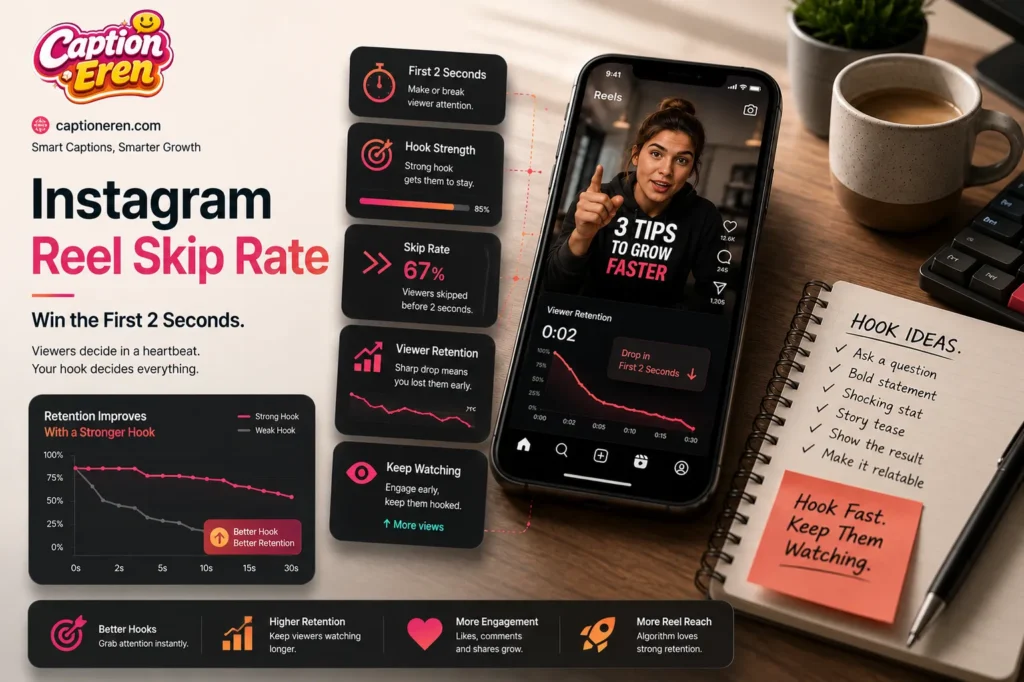
This gate does not operate in isolation. It functions as a checkpoint that every other ranking signal has to pass through first, since a viewer who leaves in the first two seconds never generates any of the downstream engagement the rest of the algorithm is watching for. The table below breaks down how this early signal interacts with the other major Reels ranking signals Instagram has confirmed.
| Ranking Signal | What It Measures | How It Relates To Skip Rate |
| Watch Time | How long a viewer stays on the Reel relative to its total length. | A high skip rate caps watch time from the start, since viewers who leave in the first two seconds never contribute any watch time at all. |
| Sends Per Reach | How often viewers share the Reel through direct message relative to how many people saw it. | A Reel with a high skip rate rarely survives long enough to reach the viewers who might have sent it to a friend. |
| Likes Per Reach | The ratio of likes to total impressions. | Skip rate acts as a gate in front of this signal, since a viewer who never stops scrolling cannot like the Reel. |
| Saves | Whether viewers save the Reel for later, weighted heavily as a sign of lasting value. | Saves depend on a viewer reaching content worth returning to, which a high skip rate prevents entirely. |
Seen this way, fixing this one number is not just about one metric among many, it is closer to fixing the entrance to a funnel that every other signal depends on. Improving watch time, sends, and saves without first addressing a high dropout figure is like trying to grow revenue at the bottom of a funnel while ignoring a leak at the very top, where the majority of potential viewers are already exiting before they reach anything else.
A summer Reel pulled from our pool captions for Instagram collection sits squarely in this funnel too, since a strong caption cannot compensate for viewers who never made it past the opening splash.
Applying This to Your Own Captions and Hooks
This principle holds across styles, even a more understated Reel built from our classy Instagram captions list still needs a clear, legible opening moment rather than relying on tone alone to hold attention.
A strong opening line often does double duty as both your on screen text and your caption hook. If you are pulling from something like our funny Instagram captions collection, testing that same line as bold on screen text in the first second of the Reel is a fast way to see whether it holds attention as well in video form as it does written out.
The same applies to more personal or reflective content. A line pulled from our random photo dump captions list can work well as a closing thought, but pairing the video’s opening with a plainly stated hook, shown on screen within the first second, gives viewers a reason to stay before that closing line ever has a chance to land.
Common Mistakes That Quietly Increase Skip Rate
It is worth noting that skip rate sits alongside, not instead of, Instagram’s broader Recommendation Guidelines, which separately limit distribution for issues like low resolution, watermarks, or borders, regardless of how strong the hook itself performs.
A few recurring habits show up again and again in Reels with a consistently high dropout figure. Opening with a logo, intro animation, or branding element before the actual content begins is one of the most damaging, since it burns through the critical window on something that offers the viewer no immediate value. A slow zoom or pan as the opening shot has a similar effect, technically showing motion but not showing anything the viewer actually cares about yet.
Vague, curiosity only hooks are another common trap. A line like you will not believe what happens next creates intrigue without giving a scrolling viewer any concrete reason to trust that the payoff is worth two more seconds of attention. Pairing curiosity with specificity, stating enough of the topic that the promise feels credible, consistently produces a lower dropout figure than pure mystery framing, particularly for viewers who do not already know and trust the creator.
Overly long captions positioned as the primary hook create a subtler version of the same problem. A caption is not visible in the same instant as the video frame the way on screen text is, and a viewer relying on the caption has already had several opportunities to scroll past before finishing it. Moving the actual hook into the video itself keeps the critical information where a scrolling viewer is guaranteed to see it first.
Finally, inconsistent pacing across a creator’s own content can quietly train an audience toward higher dropout numbers over time. If a creator’s Reels frequently open with a slow build up, viewers may develop an expectation of a slow start and begin scrolling out of habit. Breaking that pattern deliberately resets viewer expectations and can improve performance across an entire content calendar.
Frequently Asked Questions (FAQ’s)
What is a good skip rate for an Instagram Reel?
A skip rate under 20 percent in the first three seconds is considered strong performance. The healthy average range for most niches falls between 20 and 30 percent, while anything above 40 percent signals the opening needs significant work.
Can I see my exact skip rate in Instagram Insights?
Instagram does not label skip rate directly as a named metric. It can be approximated by comparing total plays against three second video views for a given Reel inside professional account insights, with the gap between those two numbers representing your approximate skip rate.
Does trending audio still help if my skip rate is high?
Trending audio still provides a distribution boost, but it cannot compensate for a high skip rate on its own. Viewers decide whether to keep scrolling based primarily on what they see in the opening seconds, and a weak visual hook will produce a poor skip rate regardless of how popular the underlying audio track is.
How long does Instagram give a Reel before deciding to stop pushing it?
Under the current audition style system, early performance with non followers in the first few hundred impressions is often enough for Instagram to decide whether to expand distribution further, with a high skip rate during that window acting as an early signal to throttle back.
The Bottom Line on Skip Rate
Whether the content is a beach vacation caption or a technical tutorial, the same two second rule applies before anything else about the post matters.
Skip rate exists because Instagram needed a fast, honest signal for whether content is actually working, and swiping away in the first two seconds is about as honest as viewer behavior gets. Every other metric a creator obsesses over, watch time, saves, sends, comments, sits on the other side of that same two second gate. Treating the opening frame with the same care as the rest of the Reel, putting text on screen immediately, starting mid action, and running the freeze test before publishing, is not a minor optimization tactic. It is the difference between a Reel that gets a fair audition in front of new viewers and one that never gets far enough to be judged on its merits at all.


